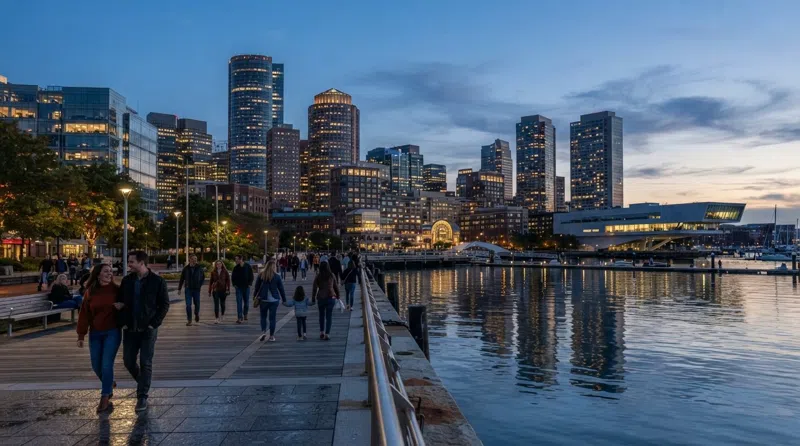
The Financial District is eight blocks that pay you back for looking up, and nearly all of it costs nothing. Between Bay and King the banks built in black steel, bronze-tinted glass and cut stone, close enough together that you can read fifty years of Canadian money from one street corner. These are working offices rather than attractions, so there is no ticket, no queue and no opening hour to organise your morning around. October changes two things. The low afternoon light does something to the glass that July does not, and when the rain comes in off the lake there is a second district running under your feet.
Eight blocks and what you are looking at
The Toronto Financial District (the downtown core, broadly Bay and King) has more free, walk-in architecture packed into a few streets than anywhere else in the city. You are looking at four bank headquarters built in sequence rather than a planned ensemble, so the interest is in the arguments between them: a 1930s limestone tower that announced the banks had arrived, the black steel grid that answered it four decades later, the gold-tinted glass across the street that answered that. It reads on foot and badly from a bus, because what matters is the scale change at pavement level, how a thirty-storey wall meets a four-metre doorway.

Figure on two to three hours of walking for the loop below, or a comfortable half day if you stop for the museum, a coffee and the market at the end. There is no door policy and no booking: these are public streets. The one practical constraint is width. The pavements on King between Yonge and University are narrow, and guided groups here are usually held to fifteen or twenty-five people for that reason. If you are walking with a party larger than that, split it.
Start at Union Station and give it fifteen minutes
Most visitors arrive at Union Station (Front Street at Bay) whether they mean to or not. It is the subway interchange, the commuter rail hub and the end of the airport train. It is also a 1920s beaux-arts hall with a ceiling worth standing still under, and almost everyone walks straight through it. Give it a quarter of an hour. It is free and open daily from roughly 5.30am to 12.45am, the lower food hall does lunch from about C$12, and if you are meeting people, assemble at the edge of the Great Hall rather than mid-floor. Commuters move through the middle at speed and will simply go around you, loudly.

Cross Front Street to the Fairmont Royal York (Front Street, directly opposite Union) and walk through the lobby, which anyone may do. This was the railway hotel the station was built to feed in 1929, and the two make sense as a pair. The Library Bar opens daily from noon, with cocktails around C$20 to C$26, and it refreshed its menu in autumn 2026, so it is not simply trading on the panelling. Afternoon tea runs at CLOCKWORK on Saturdays and Sundays from noon to 3pm by reservation, roughly C$75 to C$95 a head; a group of any size needs to book that well ahead. On a wet October afternoon the lobby is the most comfortable shelter on the route.

North up Bay to the banking halls
Walk north on Bay. Five minutes gets you to King Street and Commerce Court North (King at Bay), which was the tallest building in the British Empire for thirty years and still has the grandest interior on this walk: a vaulted, coffered banking hall that belongs to a more confident era of cheque-writing. Treat it as a lobby you are being allowed into, not a venue. There is no ticket and nothing to book, access is weekday business hours and entirely at building security's discretion, and you should keep your group small, quiet and brief. If you are leading other people, do not promise them they will get in.

A minute away is the Design Exchange (the old Toronto Stock Exchange building, 234 Bay). The interior is now a private, bookable event space rather than a drop-in design museum, so unless an event happens to be open to you, this is an exterior stop, which is fine, because the reason to come is on the street anyway. Charles Comfort's 1937 stone frieze runs across the facade and shows a procession of top-hatted figures with a worker's pocket being picked. It is one of the few moments where the district openly mocks itself, and you can stand on the pavement and read it for nothing.

South-west, inside the black towers of the TD Centre on Wellington West, the TD Gallery of Indigenous Art is a single compact room of Arctic sculpture at a standard most paid museums would advertise. It is free, walk-in, no booking, and fifteen quiet minutes is the right length. Two caveats: it was renamed from the TD Gallery of Inuit Art, so older signage and guidebooks will not match, and the space is not fully accessible. Because the room is small, a party of more than about ten should filter in a few at a time rather than arrive as a block. It opens at weekends, which matters in a district where most things do not.

Brookfield Place, Calatrava's canopy and the Cup
Back east to Bay and Front for Brookfield Place — Allen Lambert Galleria (Bay at Front), the white tree-like ribs that most people leave Toronto with a photograph of. Santiago Calatrava designed it as a public thoroughfare, so it is free and open seven days, and the light decides when you go: mid-morning, when the sun rakes down through the canopy, rather than at the lunchtime crush when it is a corridor of people on their phones. Building security is relaxed about photography but will ask tripods and larger tours to keep the central aisle clear, so shoot from the sides.

The Hockey Hall of Fame (inside Brookfield Place, Front at Yonge) is the one paid museum in the district and the one stop that earns its ticket even if you have never watched a game, purely for the vaulted former bank chamber where the Stanley Cup sits. Admission is C$29.95 adult, C$24.95 senior, C$19.95 for youth aged four to thirteen and free under three, plus tax. Groups get dedicated rates and should book in advance through the admissions office, which will also split a large party, because the Great Hall bottlenecks badly and nobody enjoys queueing inside a museum. One date to note if your trip runs late: it closes for Induction Day on 9 November 2026.

The PATH is the October answer
The PATH is thirty-odd kilometres of climate-controlled tunnel threaded under the whole district, and in October it is the reason a wet afternoon does not end your plans. It is free and open to everyone, but it is not one building: it runs through dozens of private ones, each with its own rules, signage and closing time. Walk it before 11.30am or after 2pm; in the lunchtime surge a group simply cannot hold together.

Be realistic about hours. Many office connectors shut between 6pm and 7pm on weekdays and most close on Sundays, so the PATH is a weekday asset rather than an any-time one. If you are counting on it to get from Union Station to the core without a coat, check that your leg of it is open before you commit. The retail spines stay lit long after the office links are locked.
Coffee that the office actually drinks
Pilot Coffee Roasters — Bay Adelaide Centre (Bay at Adelaide) is the Bay Street coffee stop rather than the tourist one. Counter service, small room, Monday to Friday 7am to 3.30pm, around C$4 to C$7. It works for two or three people and not at all for a group of fifteen, and it closes at weekends like most of the core, which tells you who lives here and who only works here.

Five minutes east, Dineen Coffee Co. (140 Yonge at Temperance) is the reliable Saturday option, in a restored 1897 building with high ceilings and more room to sit. Walk-in only, no reservations, coffee about C$4 to C$7 and pastries C$5 to C$8. It is happy with a small group but fills at weekday lunch. On a weekend walk, plan your coffee here and not on Bay.

Two views, one of which comes with a bar stool
Canoe Restaurant & Bar sits on the 54th floor of the TD Bank Tower (Wellington West) and holds the best view in the district that is not a ticketed observation deck: rail corridor, lake, and the tower tops you have just walked under. Dinner is C$$$$, with mains roughly C$55 to C$75; online bookings take up to twelve guests, parties of nine to twelve go on a set Chef's Choice menu, and anything larger goes through private dining. The cheap way in is a drink at the bar, with walk-ins from 6.30pm subject to space. Check the calendar first: it is closed Saturdays and Sundays, and closed on 12 October 2026, which catches out a great many weekend visitors.

The paid viewpoint most people want is the CN Tower, ten minutes south-west of Union Station on foot, open daily 9.30am to 11pm. General admission starts from about C$47 adult, The Top (formerly the SkyPod) adds roughly C$12 to C$20, and EdgeWalk, which runs in small batches from late April through October and only when the weather allows, starts from about C$199. Book a timed slot instead of queueing, and go at the end of the day rather than the start, so you can look down and name the towers you have been standing under.

Where the walk ends
The Park at CIBC Square (Bay, just south of Front) is an elevated public park bridged over the rail corridor. It doubled in size in 2026 and is still largely unknown to visitors, which makes it the cleanest new vantage point on the southern edge of the district and the natural finish for an architecture walk: you get the skyline you have just crossed, assembled, with grass under you. It is free and informal groups are fine; organised events need building permission.

If you would rather end with lunch, St. Lawrence Market is ten minutes east along Front Street. Entry is free, it takes any size of group, and lunch runs about C$10 to C$20. The South Market trades Tuesday to Sunday and the Saturday farmers' market opens at 5am; aisles are tight at the Saturday peak, so bring a group on a weekday morning or after 1pm. It is closed on Mondays, including Thanksgiving Monday, 12 October 2026.

Going with a guide or going alone
The district is self-guidable and free, so the only reason to pay is interpretation, and there is one option built specifically for this. The Toronto Society of Architects — Towers Walking Tour runs Saturdays from 1.30pm to 3.30pm, about 120 minutes, C$15 general admission and free for members, led by people who design buildings in this city. Walk-ups are taken subject to capacity and exact change is required; a larger group should book rather than turn up. The 2026 season runs to mid-October, so an October visit catches the last dates rather than a full choice of them. Plan your Saturday around it.

Broader commercial walking and cycling tours cover the district too, and they operate seven days a week, from about 89 USD per person. The booking system flags the most popular of them as likely to sell out, so if a guided half day is the spine of your trip, reserve it before you fly rather than on the morning. Going alone costs nothing and loses only the commentary.
Best time to go
Weekday mornings are the strongest window. The banking halls are only accessible in business hours, Pilot is weekdays-only, the PATH is fully connected, and Brookfield Place has its best light before 11am. Aim to be on Bay Street by 9.30am, do the towers and halls before 11.30am, and be out of the tunnels before the lunch surge.
Saturday is the other good day, but a different one. You get the architect-led tour at 1.30pm, Dineen for coffee, the TD Gallery of Indigenous Art, Brookfield Place and the farmers' market, but no banking halls, no Canoe and a patchy PATH. Sunday is thinnest: Union Station, the Royal York, Brookfield Place, the Hockey Hall of Fame and the market are open, and most of the rest is not. In the specific window this is written for, 12 October 2026 is Thanksgiving Monday, with both Canoe and St. Lawrence Market closed.
On weather, October in Toronto swings from fifteen degrees and clear to five degrees and sideways rain inside a week. Build the walk so that the PATH, Union, the Royal York lobby and Brookfield Place are your indoor fallbacks, and keep the CN Tower flexible: on a low-cloud day the view is worth nothing and the ticket is still C$47.
Is it worth it
Yes, with a caveat about expectations. There is no gate here. It is a dense, legible piece of 20th-century city that happens to be free, and what you get out of it scales with how much you are prepared to look up and read a facade. It suits architecture and design travellers, photographers, anyone with half a day between a train and a hotel check-in, and couples who like walking and ending somewhere high. It suits families less well: the Hockey Hall of Fame carries that part of the day almost alone. Large organised groups should expect to be split at the banking halls and the small gallery, and nobody should promise them interiors.
If your trip has only one half day downtown, this is a reasonable way to spend it, especially in weather that rules out the islands or the lakeshore.
Practical notes
Getting there. Union Station is on subway Line 1 and is the terminus of the UP Express from Pearson, about 25 minutes from the airport. King Station sits in the middle of the district, and the 504 streetcar runs along King itself. A contactless card or a Presto tap covers a single TTC fare; the whole walk is flat and well paved, and you will not need transport between any two stops here except the CN Tower, which is still walkable.
Cash and cards. Cards are accepted everywhere on this route with two exceptions worth carrying notes for: the architect-led tour asks for exact change, and some market stalls prefer cash.
Timing. Two to three hours walking, four to five with the museum and lunch. Weekday mornings for interiors, Saturday for the tour and the market, and check 12 October 2026 closures if you are here that week.
Budget. The walk itself, the galleria, the banking halls, the TD gallery, the PATH, the elevated park and the market hall are all free. Add roughly C$30 for the Hockey Hall of Fame, C$15 for the architect-led tour, about C$47 and up for the CN Tower, and C$20 to C$26 for a cocktail at altitude. Call it a free day, or about C$95 with everything.
Staying here. Sleeping in the district buys you the quietest downtown weekends in the city and a two-minute walk to Union, at the cost of a core that empties after 7pm. Compare rates and locations with Toronto hotel search, and read the rest of the city alongside it in our Toronto guide.